SaaS Business for Sale: How to Find and Vet One in 2026
How to evaluate a SaaS business for sale in 2026: revenue multiples, listing channels, revenue-quality tests, operational diligence and deal structure.

A median transaction value of 4.5 times revenue across 543 private SaaS acquisitions since 2015 sounds like a clean rule to price any listing against, but the annual figures tell a different story, according to Aventis Advisors' SaaS valuation multiples dataset. That median hit 5.4x in 2022, dropped to 3.7x in 2023, slid to 2.9x in 2024, and recovered to 3.8x in 2025. The same business, with the same churn and the same codebase, was worth a third less depending on the month it went to market.
If you're a first-time buyer scrolling through a SaaS business for sale, that spread should reframe everything. The asking price is an opening position, not a conclusion. What determines whether you close the deal and whether the subscription revenue still bills twelve months after handover is durability and structure.
Where to Find SaaS Businesses for Sale
Sourcing channels aren't equally transparent, equally priced, or equally slow. A first-time acquirer usually starts with marketplaces because they're visible, but off-market channels often surface better-documented deals before anyone else sees them. Here's how the main routes compare.
| Channel | What you typically find | Watch out for |
|---|---|---|
| Dedicated SaaS marketplaces such as Acquire.com, Flippa and BootstrapArena | Side projects up to seven-figure ARR businesses, some with revenue read from a connected billing provider | Many listings still rely on self-reported figures; check whether revenue is provider-verified |
| Startup brokers and M&A advisors | Larger, prepared deals with data rooms and seller representation | Success fees and a buyer-qualification process; slower timeline |
| Founder communities, newsletters and social feeds | Off-market deals shared before they are ever listed | Thin documentation, founder-supplied numbers, fast-moving competition |
| Direct outreach to a product you already use | Businesses that never listed and have no asking price | You must propose both valuation and structure; few comparables |
| Secondary markets and VC-led processes | Recapitalisations and partial exits in larger companies | Institutional buyer set, longer process, different terms |
Dedicated SaaS marketplaces are the fastest way to build a screening habit. Listings there range from side projects to seven-figure ARR businesses, and the key differentiator is whether revenue is read from a connected billing provider or claimed. A listing with a connected Stripe account showing MRR and a twelve-month revenue chart tells you the number was real last month. A listing with a screenshot of a dashboard tells you the founder knows how to take a screenshot.
Sort listings in seconds with these signals. Look for MRR and ARR stated as numbers rather than ranges, a twelve-month revenue chart instead of a single snapshot, the billing provider named, business age, customer count, screenshots of the product, and a stated reason for selling. If any of those are missing, ask for them in the first message or move on.
Practical rule: Set alerts on two or three marketplaces, skim twenty-five to thirty listings before forming any view of market pricing, and shortlist only three to five for diligence. Cross-border sellers and NDAs slow access to financials, so confirm jurisdiction and data-room terms before you spend a week on a listing.
How the SaaS Resale Market Works in 2026
Industry transaction data recorded 2,107 SaaS mergers and acquisitions in 2024, compared with 2,095 in 2023, in The SaaS Barometer's M&A volume and valuation analysis. That is a broad, liquid market where thousands of transactions close every year, not a niche corner of small business sales. Volume alone, however, says little about what a first-time acquirer can close. The pricing cycle, the quality of recurring revenue, and the financing structure decide whether a deal survives contact with diligence.
Pricing is cyclical. The same recurring-revenue profile can attract materially different valuations depending on interest rates, buyer confidence, and growth expectations. A multiple is the opening bid in a negotiation, not the answer. The central question is what portion of revenue will still bill twelve months after handover, and whether the payment terms leave room for that risk. Historical revenue, recurring-revenue trends, and verifiable financial data are the context every later step depends on.
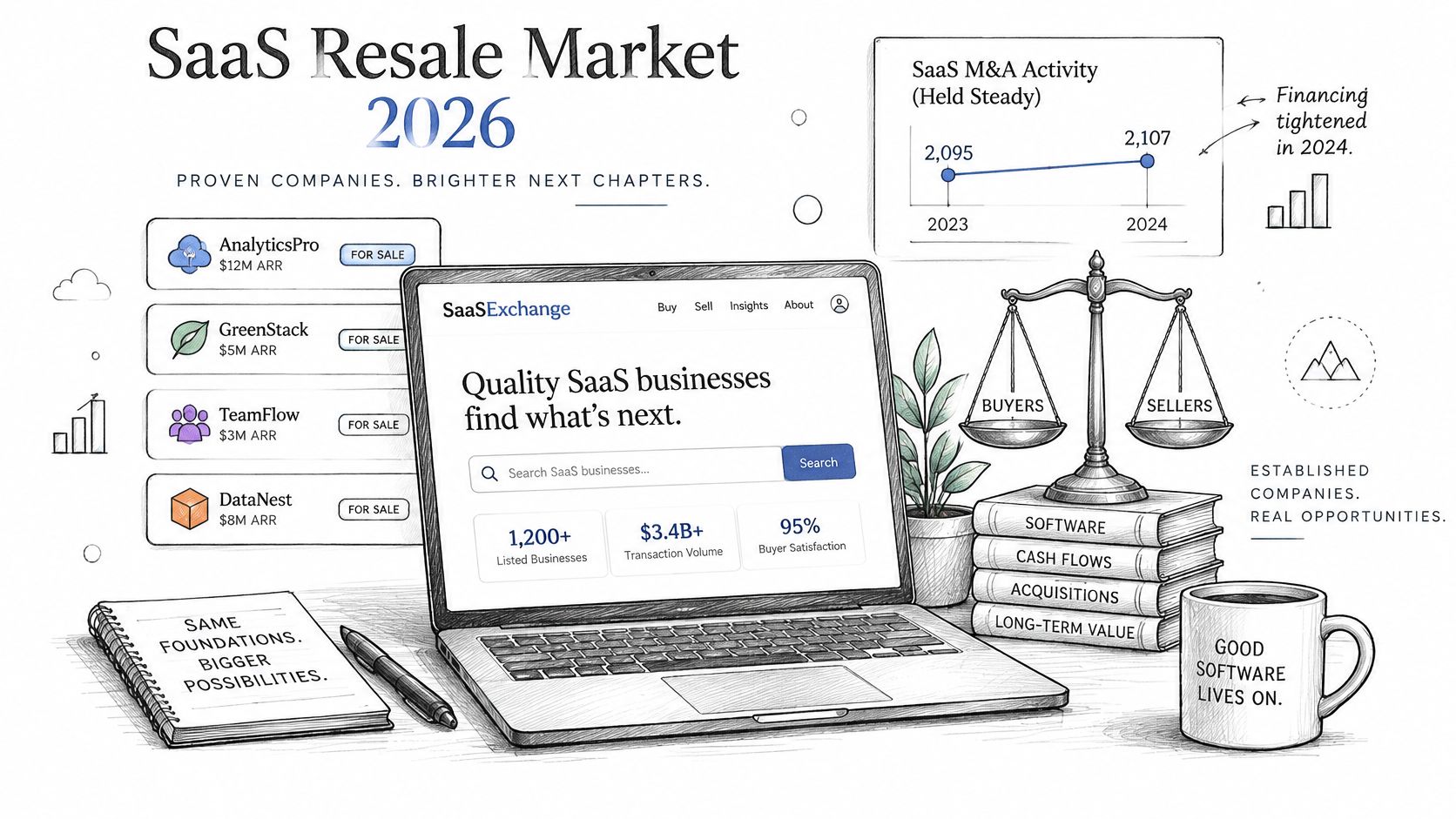
A SaaS business works like a subscription machine. The code is the engine, but the thing being sold is the recurring customer relationship that pays for it. That distinction separates the three sellers you'll meet.
The Three Sellers You'll Meet
The bootstrapped founder-operator runs the business day to day and is usually the most negotiable on structure because they want out cleanly. Their reported numbers are often real but founder-dependent, meaning retention drops when they leave unless the handover is planned.
The studio or portfolio seller divests a product out of a stable of projects. Their financials tend to be cleaner and their process more professional, but they price against an internal hurdle rate and won't chase a marginal negotiation.
The runway seller needs cash quickly. Their urgency can produce a discount, but it also means rushed documentation and a compressed diligence window, which raises your risk.
Verified MRR is still not transferable earnings. Before accepting a headline multiple, request the billing exports, customer-level churn history, refund records, payment processor statements, and any documents explaining how support, infrastructure, and growth currently get paid for. Then compare those costs with what the buyer will carry after closing. A reasonable price is the one that still works when revenue durability, owner dependency, and financing terms are priced in.
Valuation Benchmarks to Price Against
The table below gives you the numbers to price any listing against, drawn from a dataset of 543 private SaaS acquisitions with disclosed multiples since 2015.
| Period or deal size | Median multiple | What it reflects |
|---|---|---|
| Full period, 2015 onward | 4.5x revenue | Median transaction value across 543 private SaaS acquisitions with disclosed multiples |
| 2022 | 5.4x revenue | Peak pricing immediately before the correction |
| 2023 | 3.7x revenue | Higher rates and tighter acquisition financing |
| 2024 | 2.9x revenue | Trough of the cycle |
| 2025 | 3.8x revenue | Partial recovery toward the long-run median |
| Deals below $5 million | 3.3x revenue | Smallest disclosed transactions, closest to typical bootstrapped deals |
| Deals of $5 million to $20 million | 3.2x revenue | Lower middle market |
| Deals of $20 million to $50 million | 3.0x revenue | Larger transactions with mixed margin profiles |
Run the arithmetic on every listing. Implied multiple equals asking price divided by ARR. A business at $600,000 ARR asking $1.98 million implies 3.3x. That same business priced at the 2024 median of 2.9x would be $1.74 million, a $240,000 gap created by market timing alone, with nothing about the business changed.
Four adjustments move a single company up or down inside its band. Growth rate shifts the multiple the most: a business growing 30% year over year justifies a higher multiple than one flat for two years. Gross and net retention show whether the revenue base compounds or leaks. Profitability and gross margin distinguish a real software business from a services wrapper. Customer concentration cuts the multiple fast when one account carries too much of the revenue.
For a fuller walkthrough of the math behind these adjustments, use BootstrapArena's SaaS valuation guide. A separate primer on small business valuation methods from RNC Group explains why seller's discretionary earnings often replace revenue multiples in the smallest deals. Small transactions are frequently argued on SDE rather than revenue, so ask which basis an asking price uses before you benchmark it.
The caveat that closes every valuation conversation: a defensible multiple is not the same as a financeable deal. You'll see why in the financing section.
Checking Whether the Revenue Survives the Handover
A billing connection proves the number was real last month. It doesn't prove the revenue survives a change of owner. That gap is where first-time buyers lose the most money. Verified MRR is useful evidence, but it is not transferable earnings. The question is what still bills twelve months after handover, and what financing the buyer can close once revenue durability is priced.
Retention is the first test. A business can look healthy in aggregate while losing part of its recurring revenue every year, then masking that loss with upsells. When expansion stalls, churn shows up in the bank balance. Read gross and net retention together: gross retention shows what leaks, while net retention shows whether expansion covers the leak. A headline multiple that assumes both stay strong may be the opening of the negotiation, not the answer.
A marketplace displays what the billing provider reports without auditing the underlying business, so verification is a floor, not a ceiling. Treat a verified billing connection as the start of diligence. The listing tells you what the provider saw. It does not tell you whether customers stay after the founder leaves, whether pricing holds at renewal, or whether usage growth improves margin instead of eroding it.
Build a revenue durability profile
Request twelve to twenty-four months of billing exports and a cohort table, not screenshots. Then fill in this profile for every shortlisted business.
| Metric | What to request | Red flag |
|---|---|---|
| Gross revenue retention | Twelve-month cohort export | A falling cohort base, or no cohort view at all |
| Net revenue retention | Expansion versus churn by cohort | Reliance on expansion to mask churn |
| Customer concentration | Top 1, 5 and 10 accounts as a share of MRR | Any single account carrying too much of recurring revenue |
| Annual versus monthly mix | Invoice list and prepayment schedule | Large annual prepayments presented as earned revenue |
| Discount depth | Coupon and grandfathering history | Deep discounts that expire or reprice at renewal |
| Founder-attributed revenue | Accounts the founder personally sold or supports | Renewals that depend on the founder relationship |
| Refunds and chargebacks | Processor dispute and refund report | Refunds rising across the last two quarters |
| Infrastructure and vendor cost | Hosting, API and model provider invoices | Costs scaling with usage faster than revenue |
Annual prepayments flatter cash while earned revenue lags. If much of ARR arrived as annual invoices, the deferred revenue line tells you how much money is already committed and how much you will earn over the next twelve months. Founder-sold accounts often churn at first renewal, because the relationship walked out with the founder. For a clear explanation of how MRR and ARR map to billing reality, use BootstrapArena's MRR vs ARR guide.
The deeper point for a first-time acquirer is simple. Price the multiple from the durability profile, then structure the deal around what remains uncertain. Financing terms, holdbacks, and seller support can absorb risks that a spreadsheet at a single multiple cannot. Revenue that survives handover is worth paying for. Revenue that depends on the founder, a few accounts, or expiring discounts needs a different price or a different deal.
Operational Diligence the Listing Will Not Show You
Financials tell you what the business earned. They don't tell you whether the person buying it can keep it running. Run this checklist inside a two-week diligence window, and write your pass and fail thresholds down before opening any listing. A charming founder can move the bar mid-diligence if you haven't fixed it in advance.
Codebase and infrastructure health. Request a screen-share of the admin panel and the deployment log. When was the last deploy? Who holds the keys to the hosting accounts, the domain registrar, the CI pipeline? If the founder can't answer in the same call, that's a fail.
Hosting and third-party costs. Ask for the last three hosting invoices and the API provider bills. Call out vendor lock-in: a business running entirely on one platform's proprietary runtime is harder to migrate than one on standard infrastructure.
Technical rule: If a single vendor controls the hosting, the billing, and the API layer, treat the stack as a concentration risk just like a single customer.
AI-specific exposure. If the product depends on a large language model, ask which model, who owns the training data, and how usage-based margin pressure affects gross margin when a customer quadruples usage. Security posture, data rights, and defensibility sit in the same review.
Support load. Request a support inbox export for the last two months and count ticket volume per week and hours per month. If the founder handles every escalation personally, you're buying a job.
Acquisition channels. Ask for a traffic report and a breakdown of where MRR comes from. A business that gets most of its signups from organic search or a single marketplace is one algorithm change from a revenue cliff.
Contracts and IP. Review enterprise agreements, data processing terms, reseller and affiliate obligations, and IP assignments from contractors and former co-founders. Gaps here take months to unwind after close. For a buyer-side view of where these legal risks usually surface, Kons Law on acquisition legal risks from Kons Law walks through the categories that derail deals.
Transition plan. Get a written thirty-to-ninety-day handover before you commit. What the founder agrees to document, who stays on call, and how many hours per week. For the metric definitions behind this checklist, see BootstrapArena's SaaS metrics guide.
Financing the Purchase and Structuring the Deal
Acquisition lending reached 6,910 loans totaling $8.12 billion in 2025, with an average loan of $1.18 million, according to Analytics Loan's small business acquisition market report. Those figures show an active market, but the average ticket sits above many bootstrapped SaaS listings. That creates a practical mismatch. Buyers often want seller participation, while sellers often want a clean exit at the headline price.
That gap is the binding constraint. A fair valuation does not produce a financeable deal when the seller will not finance and the lender will not underwrite a sub-$1 million bootstrapped SaaS business. The multiple is only the opening position. The key question is what cash closes, who carries retention risk, and what still bills twelve months after handover.
| Structure | Cash at closing | Who carries the risk | Fits when |
|---|---|---|---|
| All cash | 100% of price | Buyer | Buyer is well capitalised and the business is clean with low concentration |
| SBA-style acquisition loan | Down payment set by lender, loan funds the balance | Buyer with lender recourse | US-based buyer, established revenue, deal inside lender size limits |
| Seller note | Down payment plus deferred payments; notes commonly 10-16% of deal value | Shared, seller subordinated to the buyer | Seller wants a headline price and will accept deferred payment |
| Earnout | Base payment at closing plus payments on retained MRR | Mostly the seller | Revenue concentration, founder dependency or aggressive growth claims |
| Staged acquisition or equity rollover | Partial at each stage | Shared | Larger deals, or a founder staying on to run the business |
An earnout tied to retained MRR protects you against churn. If a wide swath of accounts leave in the first year, the seller shares that loss. A seller note puts the seller behind you on retention and makes the transition period negotiable, because part of their proceeds depends on the business surviving the handover. That matters more than a small difference in headline price. A lower multiple with cash at close may beat a higher multiple held together by seller goodwill.
International buyers, solo acquirers, and purchasers of sub-$1 million businesses often fail conventional lending tests entirely. For them, seller financing is a condition of the deal rather than a nice-to-have. The structure also changes your diligence order. If the seller funds part of the price, you need clean revenue records and a handover plan before you argue over the last point of the multiple. If an earnout is proposed, define retained MRR, refunds, discounts, downgrades, and annual billing treatment in writing.
For a regional perspective on how structure affects both buyer and seller proceeds, selling your business in Northern Wisconsin from Lein Law Offices covers the practical terms that matter in small transactions. Structure, not valuation, is frequently the binding constraint, so it belongs in the first seller conversation rather than after a letter of intent is drafted. Ask what the seller will carry, how long payments run, and whether they will stay available through transition. Those answers determine whether the deal can close.
Comparing Two Listings That Look Alike
Say you're looking at two listings priced at similar multiples. Both are bootstrapped SaaS businesses with verified revenue. Here's how the framework separates them.
Listing A shows $40,000 MRR, or $480,000 ARR, is three years old, and its largest customer is 30% of revenue. The founder personally handles all sales and support, billing is monthly, and the asking price is $1.58 million, about 3.3x. Listing B shows $35,000 MRR, or $420,000 ARR, no customer above 8% of revenue, 60% of revenue billed annually, support handled by two contractors, and an asking price of $1.39 million, also about 3.3x.
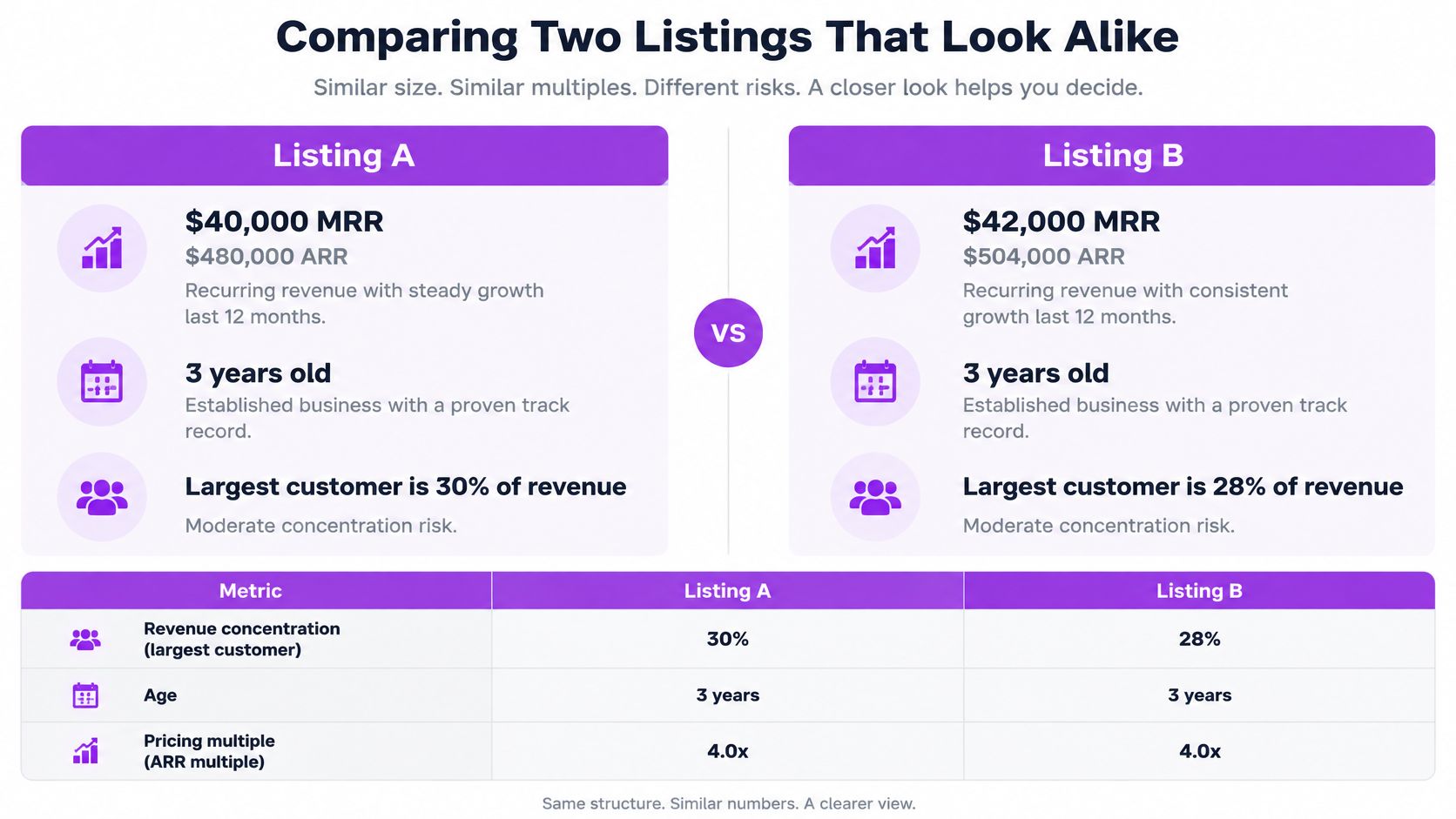
Identical multiples hide different deals. Listing A's concentration and founder dependency push its durability-adjusted value toward the bottom of the band, well below the 3.3x median once the top account's churn risk is priced in. Listing B holds closer to the 3.3x median because its revenue spreads across accounts, support is delegated, and annual billing gives the new owner breathing room on cash.
The structure shift is just as stark. Listing A only closes with a seller note and an earnout tied to retained MRR, because no lender wants that concentration and no buyer should take it all on cash. Listing B can carry an acquisition loan with a short transition and more cash down, because the risk is distributed rather than concentrated in one customer and one founder.
Comparison rule: Two businesses at the same multiple are rarely the same deal. Compare listings on durability and structure at the same time, not on price alone.
Your Next Step Before You Make an Offer
Here's the sequence that keeps enthusiasm from overriding diligence.
- Shortlist three to five listings that publish verified revenue and a twelve-month chart.
- Request the billing export, cohort table, top-ten customer list, hosting and API invoices, support inbox export, and a traffic report.
- Score every shortlisted business against the durability profile and the operational checklist on the same day, so comparison stays apples to apples.
- Set a walk-away multiple and a minimum cash-at-closing figure before any price conversation.
- Confirm structure in the first seller call, meaning seller note, earnout, and transition period, rather than after a letter of intent.
BootstrapArena's marketplace lists SaaS, e-commerce, and mobile businesses for sale, with MRR and ARR shown alongside each business's billing-provider data. Start by browsing the listings and applying the signals from the sourcing section.
A deal is worth doing when the revenue survives the handover and the structure is financeable, not when the multiple looks like a bargain.
Find a SaaS business for sale with verified revenue and a live twelve-month revenue chart on BootstrapArena. Listings are free to browse, buyers see provider-backed MRR and ARR, and sellers can list their startup for sale at submission or later. Make an offer directly to the founder and work through structure from the first conversation.