How to Sell a Business Privately: A Step-by-Step Guide
Learn how to sell a business privately: prepare records, price realistically, protect confidentiality, compare offers and close safely.
Most advice about selling a business privately starts in the wrong place. It tells you to get a valuation, add a negotiating cushion, list the business and wait for offers. The valuation matters, but the number that decides your outcome is not the asking price. It's what clears into your account, after fees and tax, weighted by the chance each deferred dollar is ever paid.
That gap between headline price and realized proceeds explains most private-sale disappointment. An owner accepts a higher offer, the buyer's lender stalls, the earn-out is written with a metric nobody defined, and nine months later the seller has a signature and no money. Understanding how to sell a business privately is mostly about defending the cash side of that equation while keeping enough transparency in the process that a serious buyer stays.
So the advice worth challenging first is this: sell to the highest bidder. Sell instead to the bidder most likely to pay, and structure the deal so the price you agreed is the price you collect.
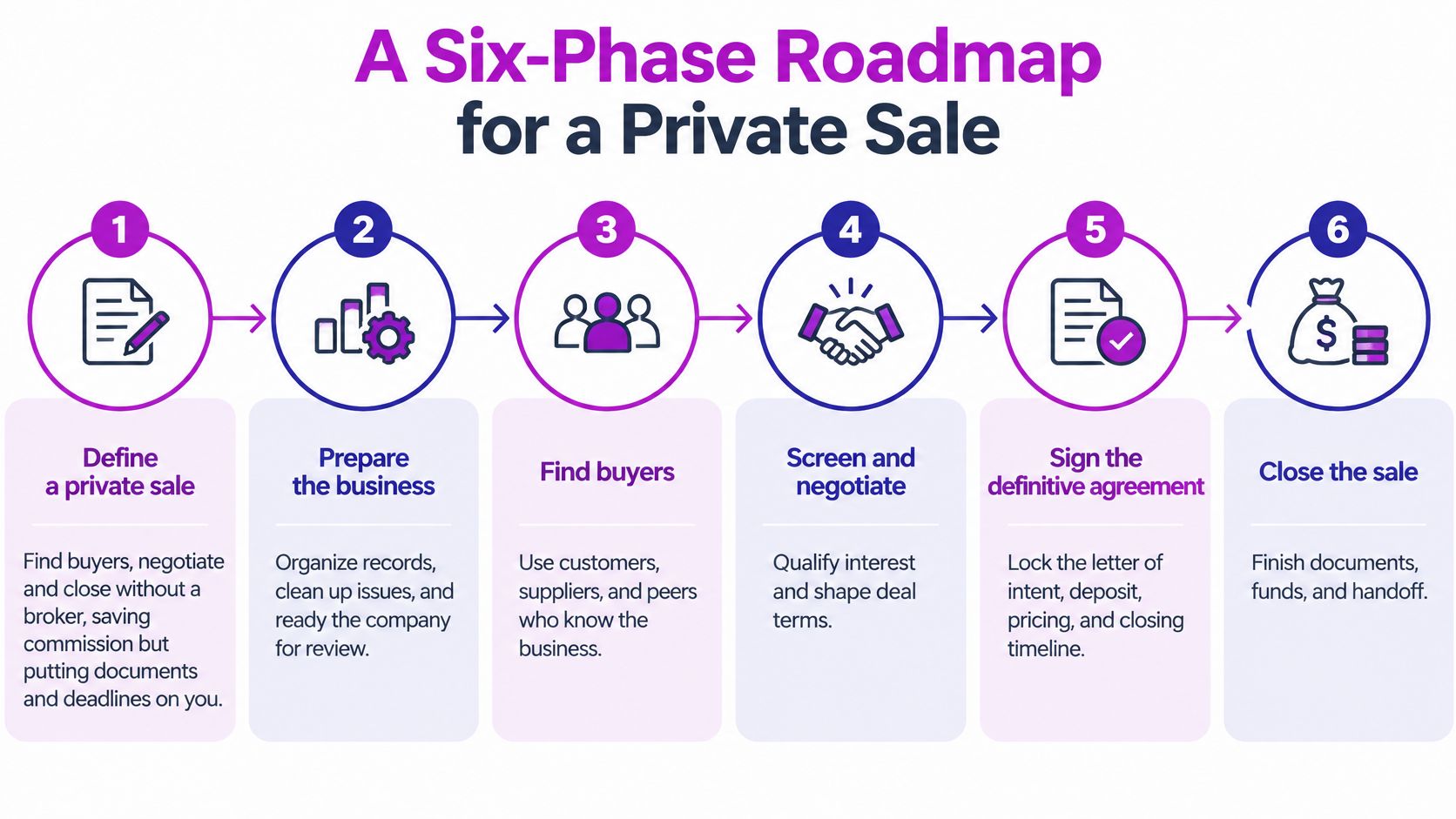
A Six-Phase Roadmap for a Private Sale
A private sale means you find the buyer, negotiate the terms and close without a broker running the process. You keep the commission and you inherit every document, deadline and awkward conversation a deal team would otherwise absorb. That trade pays off when you have buyers within reach and the discipline to run the sequence. It goes badly when "private" becomes an excuse to skip steps.
Six phases, in the order they happen:
- Prepare the records. Reconcile at least three years of tax returns, bank statements and revenue exports line by line. Phase complete when a normalized earnings sheet ties to your filed returns.
- Price the business. Normalize earnings, deduct a market salary for your own labor, then set a written minimum acceptable price and the structure you'll accept. Complete when that number is on paper and you've stopped moving it.
- Build the sale package and control disclosure. Anonymous teaser, confidentiality agreement, controlled data room. Complete when the data room opens with permissions set and an access log running.
- Find and screen buyers. Score every inquiry on funding and operating fit. Complete when you hold a shortlist of buyers who answered the money question clearly.
- Compare offers and sign a letter of intent. Rank offers by expected proceeds, not headline price. Complete when exclusivity is granted against a deposit and a written termination date.
- Definitive agreement, closing conditions, handover. Complete when funds clear and credentials transfer, in that order.
Timing is where most owners lose money. A private sale runs months, not weeks, and the deals that drag past a year usually lost momentum during diligence rather than during negotiation. Keep the business performing at the level buyers are paying for. Aggressive cost cuts during marketing show up as churn in the data room and get repriced in the purchase agreement.
Practical rule: put the six phases on one page with a target date and a named owner against every line. A timeline becomes a plan when someone is accountable for each date.
Budget the cost carefully. A private sale converts a broker commission into legal, accounting and escrow line items you schedule and pay as the deal progresses. An AmbitionCFO exit planning guide is a useful second read on sequencing that spend before you're under exclusivity pressure.
Prepare Records and Price the Business Realistically
Two tests decide whether your sale advances. The first is whether the earnings you advertise survive a rebuild from bank deposits. The second is whether your asking price sits anywhere near what buyers have paid for comparable businesses. Both are provable, and both are usually proved against you in the first two weeks of diligence.
The reconciliation a buyer will redo
Start with at least three years of tax returns, monthly profit-and-loss statements, balance sheets, bank statements, customer-concentration data, recurring-revenue cohorts, contracts, intellectual-property ownership records, contractor obligations and a schedule of owner add-backs. The U.S. Small Business Administration's guide to closing or selling a business recommends valuing both tangible and intangible assets, including brand presence, intellectual property, customer information and expected future revenue, and settling in advance how the business will operate through closing and what information the buyer may access.
Then build the normalized figure. Strip personal expenses, one-time costs and anything non-operating, and deduct a market-rate salary for the work you currently do. If your dashboard revenue doesn't reconcile to bank deposits after refunds, taxes, churn and deferred revenue, the deal dies in that conversation. A mismatch there reads as either sloppy bookkeeping or something worse, and buyers price both.
Benchmark against closed deals, not asking prices
The market gives you a range to argue from. BizBuySell's quarterly insight report recorded 2,132 businesses changing hands in one quarter, flat from the prior quarter and 7% below the same quarter a year earlier, with seller's-discretionary-earnings multiples for Main Street businesses generally near 2.0x to 3.0x. The same report found SBA financing was the most-cited obstacle, named by 38% of brokers, ahead of interest rates at 34%.
| Business group | Cash-flow multiple | Revenue multiple |
|---|---|---|
| All small businesses | 2.61x | 0.69x |
| Under $1 million revenue | 2.30x | 0.62x |
| Over $1 million revenue | 3.73x | 0.97x |
Those averages come from BizBuySell's 2025 transaction data tables, which also note a typical small-business sale timeline of 4 to 12 months. Use them as a benchmark, never as a valuation. Pick comparable closed transactions by business model and geography, apply a multiple range, then adjust downward for customer concentration, founder dependence, churn, traffic-source risk, litigation and any supplier or platform account that won't transfer.
An asking price is not an achieved price. Price for the sale you expect to close, and if you run a SaaS product, the SaaS valuation guide covers how retention and expansion revenue change the multiple a buyer will defend. Finish the phase with two documents: a one-page normalized earnings sheet and a price range with a written reason for every adjustment.
Build the Sale Package and Control Disclosure
The instinct to hide everything until a buyer is committed feels prudent and costs you deals. Excessive secrecy slows diligence and erodes trust, and buyers read it as a warning. The workable approach is controlled transparency: reveal enough to underwrite, in an order you control, with a record of who saw what.
The stakes have risen because buyers have become more selective. BizBuySell's 2025 fourth-quarter insight report found U.S. transaction volume flat in 2025 while total enterprise value rose 3% to $7.95 billion, which points the same way: stronger documentation and buyer confidence now matter more than attracting a high count of inquiries.
The disclosure ladder
- Anonymous teaser. Category, revenue range, growth trend and the reason for sale, with no company name, no location detail and no customer names.
- Confidentiality agreement. Signed before any identifying detail. If a buyer won't sign, they aren't a buyer. The Owner's Shortlist has a workable explanation of business sale confidentiality agreements if you want the clauses that protect you.
- Identity and capacity check. Verify who you're dealing with, proof of funds and acquisition experience before you send anything sensitive.
- Management presentation. Operations, team, systems, growth levers and the specific risks you know about, answered in one channel so your story stays consistent.
- Controlled data room. Separate permissions for financial, technical, legal and customer files, with an access log and a disclosure calendar.
What cannot be redacted
Customer concentration, churn, outstanding liabilities, intellectual-property ownership, tax exposure and change-of-control clauses have to be on the table early. Redacting those doesn't protect you, it just pushes the discovery to a later stage where the deal has more power over you and less patience.
Tell employees and key customers once terms are close to agreed, with a dated communication plan and named people delivering the message. A buyer who refuses to name their funding source or describe their acquisition history is a red flag, and the correct response is to pause access rather than press on.
Practical tip: give buyers read-only exports and reconciled statements. Never hand over raw billing-provider credentials, and never let a diligence request turn into live access to your revenue systems.
Find and Screen Buyers Without Losing Control
Qualified buyers come from a short list of places, and they are not equal. Start with people who already know the business: customers who depend on the product, suppliers who understand your volumes, and peers who have run something similar. These buyers move fastest because they've already done most of the diligence on you.
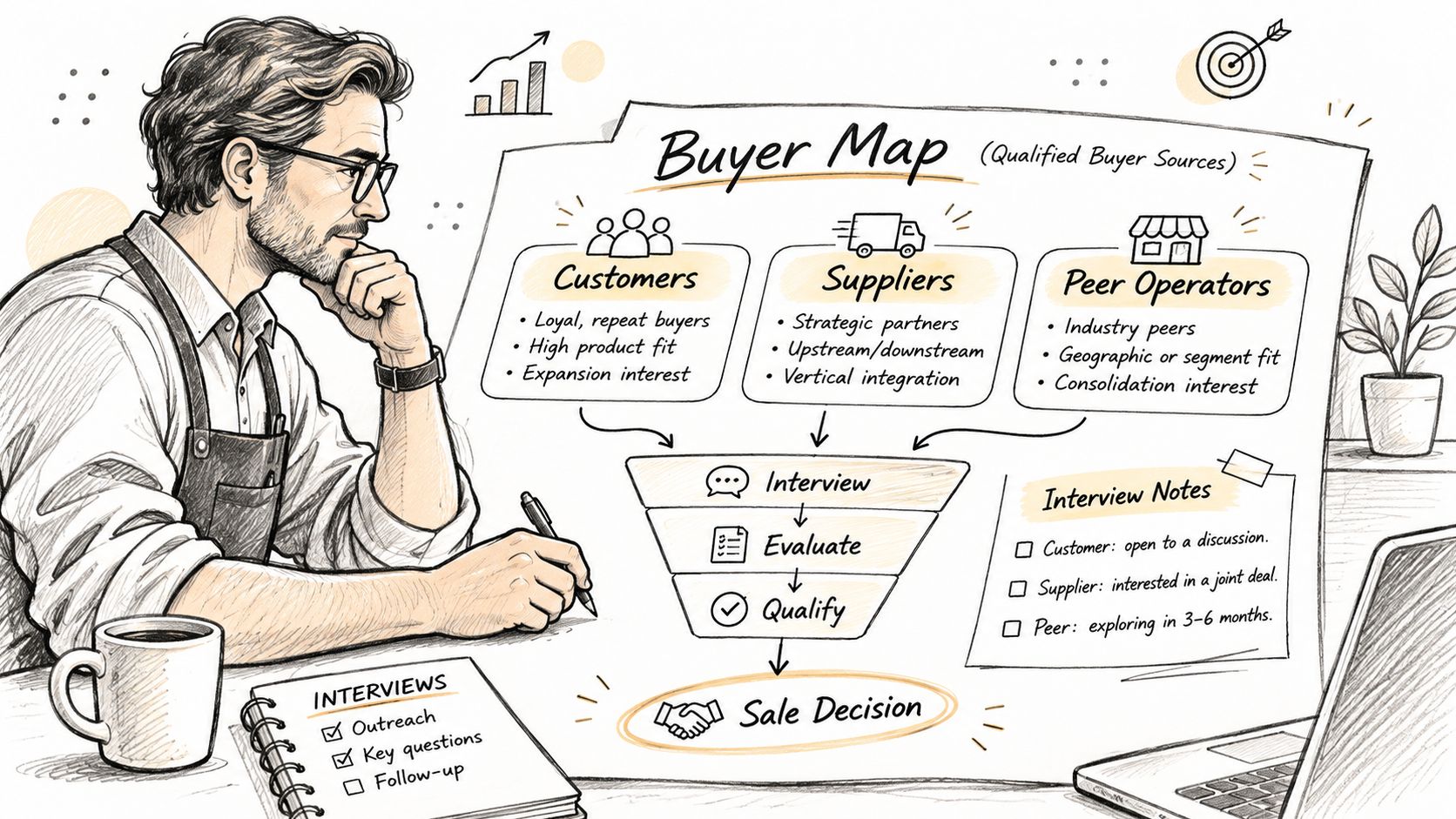
Next come operators who want into your market, including direct outreach to adjacent companies, which brings strategic pricing but also slower committees. Marketplaces make up the third channel. They deliver volume and a documented price, and on a marketplace that publishes verified revenue beside the asking price, the mechanics are simple: the buyer clicks "Make an offer", the offer arrives in the founder's inbox by email, and the two parties agree the deal directly. The SaaS business for sale guide walks through what a listing displays and how buyers read verified figures.
Volume and quality pull in opposite directions here. Direct outreach produces two or three serious conversations in a month. A marketplace produces dozens of inquiries in a week, most of them unqualified. Plan for both and staff the screening, or the inquiry flow will consume the time you need for diligence.
Screen every inquiry against five questions before you send anything:
- How will the purchase be funded? Cash, bank debt, seller financing or a mix, with a lender already identified.
- What operating experience do they have in this category? Adjacent counts. None does not.
- How much time can they commit after closing? A full-time owner-operator is a different buyer from an absentee investor.
- Why this business? A specific answer shows they've read the numbers. A generic one shows they're shopping.
- What do they need to see first? Their priority list tells you whether diligence will be organized or chaotic.
Scenario: a mobile app earning half its revenue through one app-store account will attract buyers who ask immediately about developer account transfer. Treat only the buyers who can describe the transfer steps, and the risk if it fails, as serious.
Red flags are consistent. Demanding full access before an NDA, vague financing, pressure for exclusivity without a deposit, and a sudden insistence that the seller carry a note with no security.
Compare Offers and Negotiate the Deal Structure
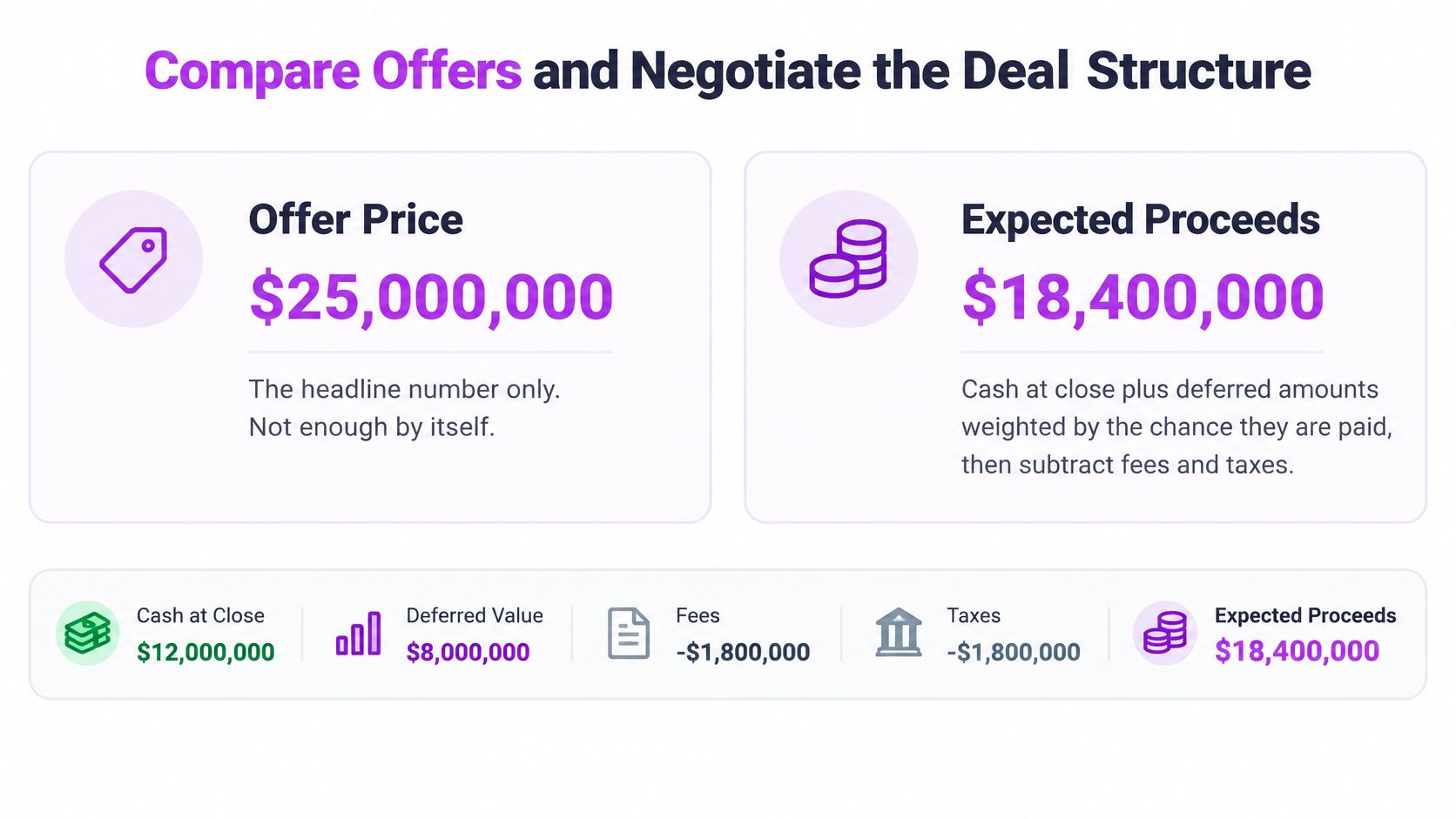
Rank offers on one number: expected proceeds. Add cash at close to each deferred amount multiplied by your honest estimate of the chance it gets paid, then subtract fees and taxes. That formula reorders most shortlists, because deferred money is priced for risk, not for optimism.
Take a $950,000 all-cash offer against $1.1 million where $600,000 sits split between an earn-out and a seller note. If the buyer's financing is fragile, the earn-out metric is undefined, and the note is unsecured, the second offer can be worth materially less than the first. The seller who takes it is usually solving for the headline.
Seller financing is normal, not a red flag. A 2023 analysis of seller financing in business sales reported that 48% of business sales involved seller financing, rising to 34% of financing for transactions between $5 million and $50 million, while for businesses below $500,000 it represented about 13% and roughly 8% to 10% for deals between $500,000 and $5 million. The same analysis is blunt about the trade: a note can bridge a valuation gap or compensate for thin bank financing, and it leaves you exposed to the buyer's future performance.
What each structure really pays
| Structure | Cash at close | Main seller risk | What to verify |
|---|---|---|---|
| All-cash offer | Full price at close | Lowest once funds clear | Buyer's proof of funds |
| Bank-financed offer | Bank-funded share at close | Deal fails if the lender declines | Lender pre-approval and debt-service coverage |
| Seller note | Part of price paid over time | Buyer default or late payment | Interest rate, maturity, security and default remedy |
| Earn-out | Portion paid only if targets are met | Disputes over how metrics are measured | Written metric definitions, reporting rights and a remedy |
| Escrow or holdback | Portion held for a set period | Claims made against held funds | Release conditions and dispute process |
The terms that protect the number
Define revenue precisely, including how refunds and chargebacks are treated, because a definition you didn't write will be applied against you. Set working-capital and inventory adjustments with a target peg and a mechanism for the true-up. If churn appears in an earn-out, specify how it's counted, who reports it and when, and what happens when the buyer's own decisions cause the miss.
Secure any note with interest, maturity, collateral and a default remedy you would enforce. Cap transition support in hours and duration, in writing, or it becomes open-ended consulting. On the SaaS side, the difference between MRR and ARR is the kind of definitional gap that turns into a post-closing dispute when a contract is billed annually.
A higher advertised price can produce a lower realized outcome when the financing is fragile or the earn-out is written so the seller is rarely paid.
Then work the steps. Rank every offer by expected proceeds. Request the financing plan from your top two, including lender contact and debt-service coverage. Have counsel read the letter of intent before you grant a day of exclusivity, and don't let enthusiasm compress that review into an afternoon.
Sign the Definitive Agreement and Close the Sale
The letter of intent sets the shape of everything that follows. What you want in it: a fixed exclusivity window backed by a good-faith deposit, the price and payment split, the working-capital peg, the target closing date and a written termination date. A vague LOI costs you negotiating strength the moment diligence starts.
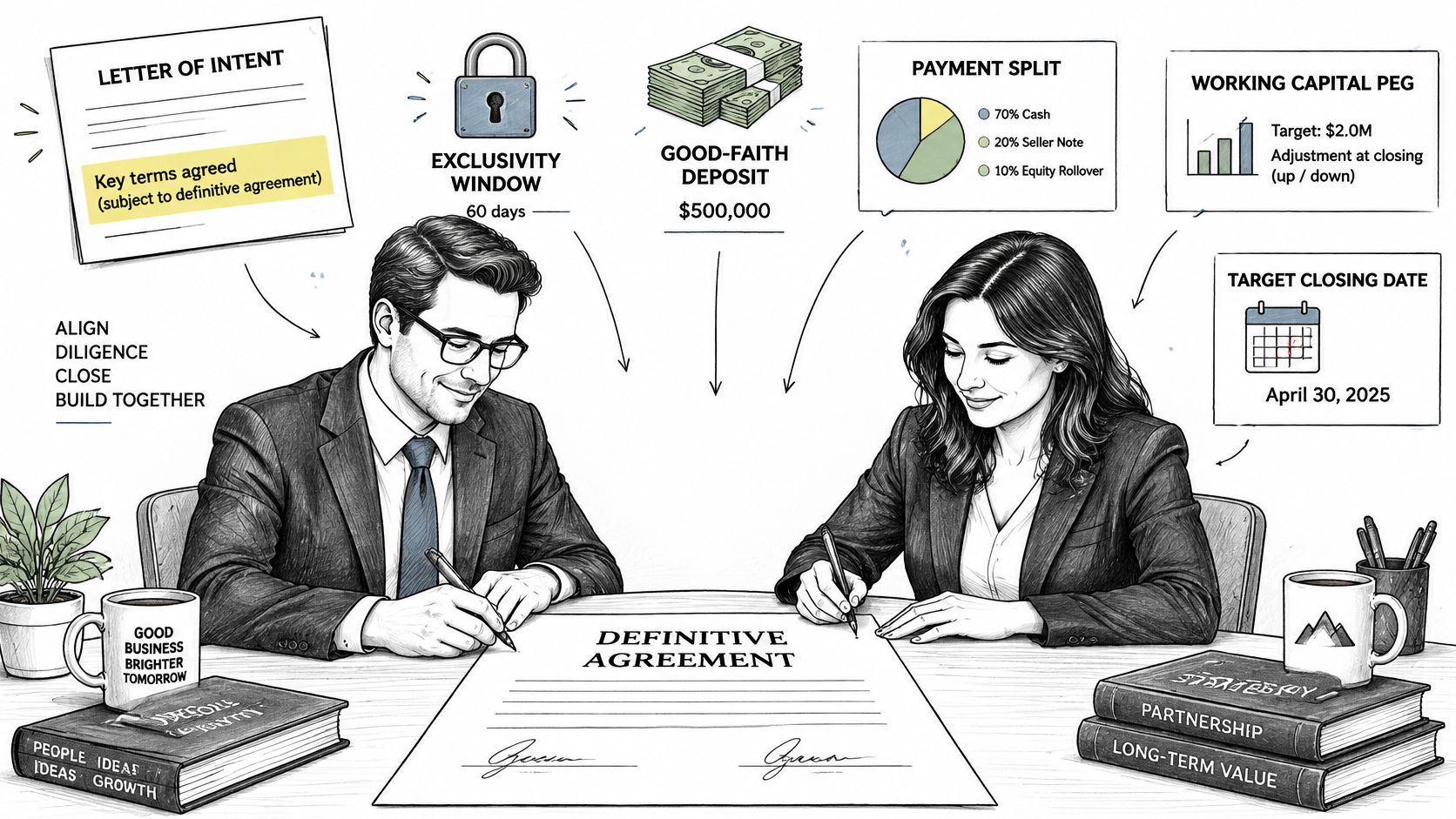
The definitive purchase agreement turns that shape into obligations. Asset versus entity purchase, representations and warranties on both sides, indemnity caps and baskets, the escrow or holdback amount and its release conditions, non-compete and consulting terms, and transition support stated in hours rather than intentions.
From letter of intent to funds released
- Close the diligence list. Answer every remaining item and post the final data-room update, so the record closes on your terms.
- Confirm the money. Get lender approval in writing and verify the buyer's equity sits in escrow or an attorney trust account.
- Assemble transfers. Bill of sale, assignment of contracts and IP, domain and platform account transfers, contractor notices, and a dated plan for telling employees and customers.
- Agree the funds flow. A closing statement covering payoffs, escrow release triggers and who wires what to whom.
- Close and hand over. Transfer credentials only after funds clear, then start the transition schedule.
After closing, three items stay live: the working-capital true-up, final tax filings, and the first reporting date on any seller note. Build the closing checklist with an owner and a date against every line.
Decide Between a Private Sale and a Listed Sale
Both routes work. Choose on fit rather than principle. A private sale suits you when two or three qualified buyers already exist, when you want tight control over who sees what, and when you can carry the legal and accounting work yourself. A listed sale suits you when reach is the constraint, when you want verified revenue shown to every inquirer, and when you're comfortable publishing an asking price.
The listing mechanics are straightforward. To sell a startup, the founder submits it as usual, opens "Want to sell this startup?" at the end of the form and enters an asking price; a business that's already listed can be put up for sale from the "Sell this startup" card on its edit page. We take no commission on marketplace sales, and the seller can remove the listing at any time.
Compare the cost lines. The private route carries counsel, accounting, escrow and tax planning as itemized bills you schedule yourself. An intermediated sale folds those into a commission. Both routes still require normalized earnings, a controlled data room, buyer screening and a price you can defend line by line, so the difference is who does the work, not whether it gets done. For transaction-side thinking on structure and valuation, AnyBPO's mergers and acquisitions guidance is a reasonable next read.
This week, pick the route, name the first document you'll draft, either the normalized earnings sheet or the anonymous teaser, and put a date on the first buyer contact.
If you're weighing a private sale and want your numbers visible to buyers before you start the conversation, BootstrapArena lets you submit a business, connect a read-only billing key and publish verified MRR alongside your asking price, with offers arriving directly in your inbox and no commission taken on a sale. You can list a SaaS product, store or app for free, keep the listing live while you test buyer interest, and pull it whenever you choose. Start with the revenue verification, because the figure buyers trust first is the one they can see.