Revenue Verification Explained: What Buyers Should Check
Revenue verification reads MRR and ARR directly from billing providers. Learn how it works, what it proves, and what it still misses.
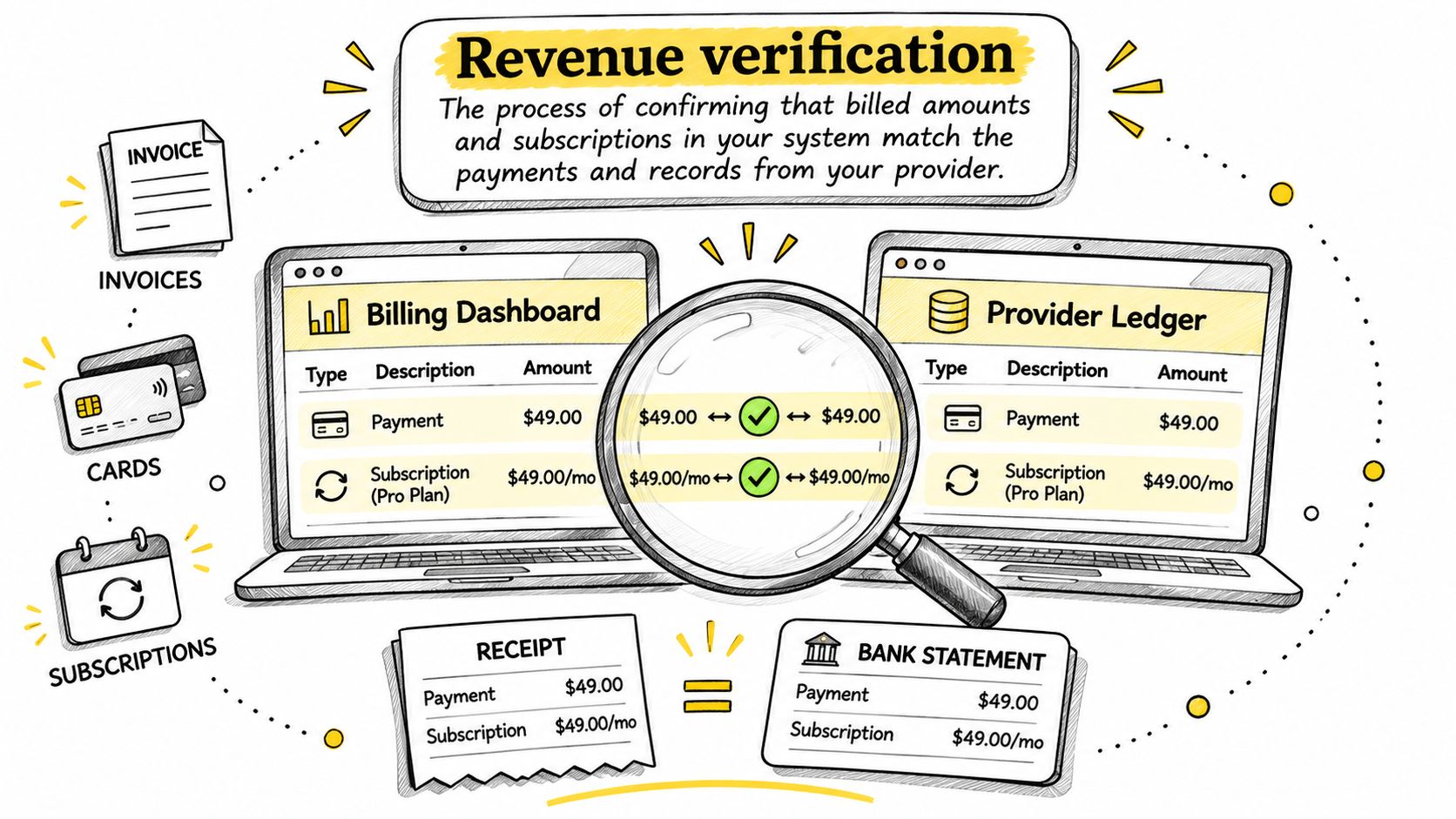
Revenue verification checks a reported revenue figure against the billing provider's own transaction records instead of taking the founder's word for it. It answers one narrow question: did the payments run through the account the seller says they did?
You're likely staring at two businesses side by side, weighing which one to buy, partner with, or benchmark against. One listing shows a healthy monthly recurring revenue figure. The other shows a smaller one. Neither number arrives with a bank statement attached, and both founders have every reason to round up. That's the gap verification exists to close, and it's also the gap verification does not fully close on its own.
What Revenue Verification Means in Plain Terms
Revenue verification means checking a revenue figure against the billing provider's own records of payments and subscriptions, not against a number the seller typed.
Think about the difference between a receipt you write yourself and a bank statement. A receipt you write proves you can write a receipt. A bank statement comes from a party that recorded the transaction as it happened, in its own ledger, for its own purposes. The provider has no incentive to flatter your business. It charged its fees and moved on.
Three parts sit inside any verified figure, and readers confuse them constantly:
- The claimed figure. Is this MRR, ARR, total revenue collected, or net revenue after refunds? Each one means something different.
- The source. Which billing account produced the number, and is that account the complete picture or one of several?
- The rules. How were annual plans spread across months, how were refunds treated, and what currency conversion applied?
A verified figure is only as good as its source and its rules. By the end of this guide you'll be able to read a verified number, identify which metric it represents, judge what it proves, and see exactly what it leaves out.
Which Revenue Figures Verification Covers
Five metrics show up on verified listings, and each carries its own meaning and its own trap.
| Metric | What It Counts | Where It Is Used | Common Trap |
|---|---|---|---|
| MRR | Active recurring subscriptions per month, tax excluded | Subscription software | Treating one-time payments as recurring |
| ARR | MRR annualized, roughly MRR times 12 | Subscription software and investor comparisons | Annualizing a single unusual month |
| Total revenue | All collected payments in a period, including one-time sales | E-commerce and mobile apps | Reading it as a growth rate or as recurring income |
| Net revenue | Total revenue after refunds and chargebacks | Any model with refund activity | Comparing it with gross figures from another listing |
| Net payout | Cash that reaches the bank after provider fees | Cash-flow checks | Confusing it with revenue earned in the same period |
The metric definitions aren't arbitrary. The IFRS 15 revenue standard, issued in May 2014 and mandatory for annual reporting periods beginning on or after 1 January 2018, separates revenue from mere cash receipts. Its five-step model identifies the contract, identifies performance obligations, determines the transaction price, allocates that price, and recognizes revenue only as obligations are satisfied. For subscription software, cash collected upfront may not equal revenue recognized immediately when the service obligation runs across future months.
That distinction matters more than most readers expect. If you want a deeper walkthrough of the recurring side specifically, this explanation of measuring predictable subscription income covers how recurring revenue is defined and why predictability matters more than volume.
A large number can still be a weak number. Say a founder runs a $12,000 launch sale in January and sells annual plans. That single event lifts the quarter's total revenue by $12,000 while adding nothing to MRR if the plans are billed once. A reader comparing that quarter against a competitor's ordinary month is comparing a spike against a baseline.
MRR follows the same rule as Stripe's dashboard: active subscriptions, per month, with tax excluded. So the figure isn't a judgment call, it's a reading of subscription status. If you want the mechanics of how that number is assembled, this guide to what MRR actually measures breaks it down. Pre-revenue businesses can be verified too, with $0 verified and the revenue line starting the day the first payment comes in.
The comparison rule: before you compare two businesses, ask which metric is shown and whether it is gross or net of refunds. A gross total against a net total is not a comparison, it's a coincidence.
How Provider-Connected Verification Works Step by Step
The mechanics are simpler than the accounting behind them. Here is the sequence a provider-connected check follows, with the reason each step exists.
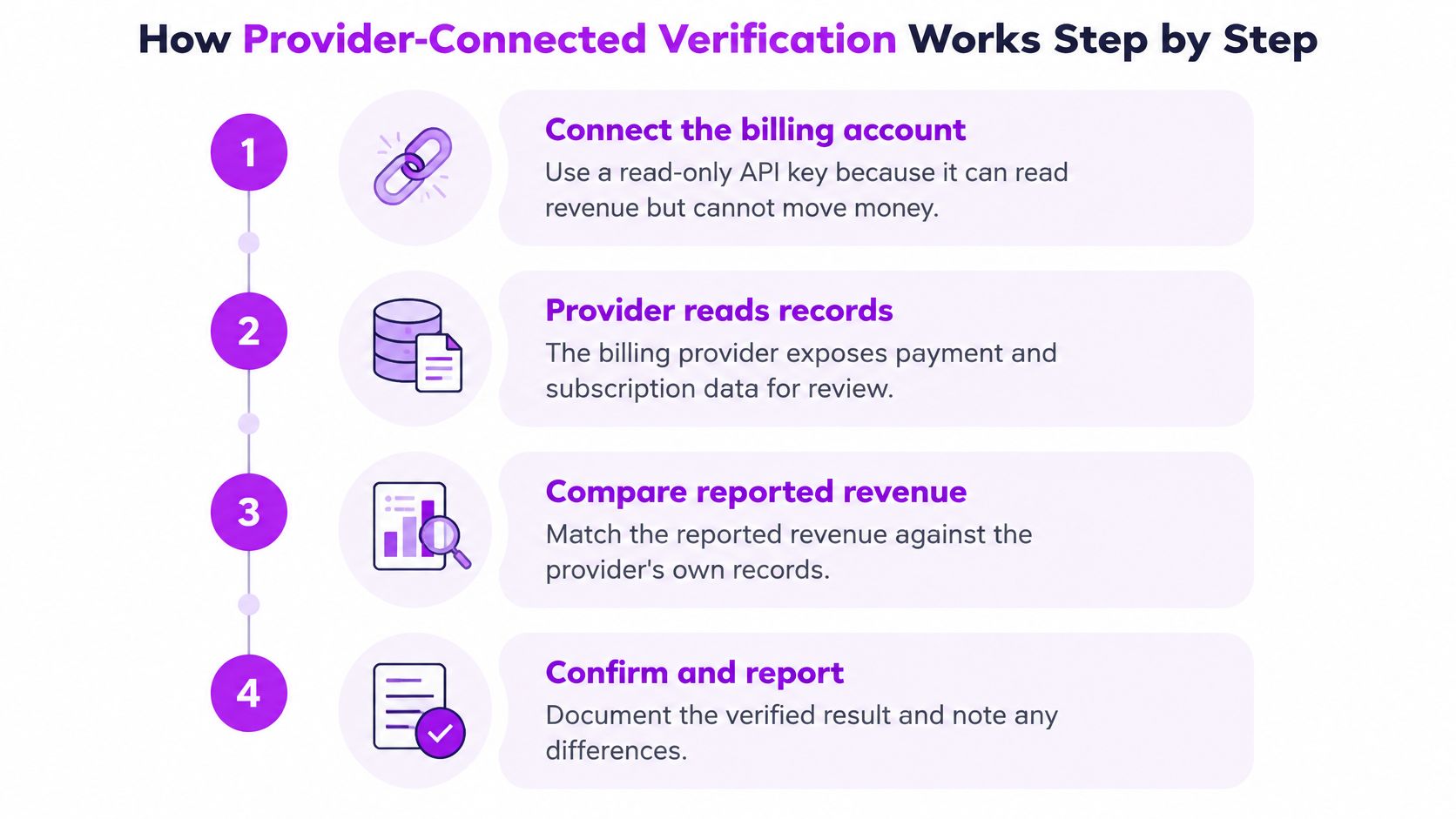
- Connect the billing account with a read-only API key. Read-only access can read revenue but cannot move money, which removes the obvious objection before it's raised.
- Refuse test-mode and sandbox keys. Sandbox keys are rejected outright, so test payments never count toward a displayed figure.
- Sync transactions and subscription status automatically. Verified revenue is read from the billing provider and synced, so no one types it in. That's the difference between a claim and a record.
- Classify every transaction. Payments split into recurring subscriptions, one-time purchases, refunds, chargebacks and provider fees. Without that split, a refund-heavy month can look identical to a clean one.
- Calculate MRR from active subscriptions. The calculation uses a written rule an independent reviewer can check against the same export, which is what makes the number arguable rather than mysterious.
- Publish MRR, ARR and the twelve-month history. The figures update as the business grows, so the chart reflects current subscriptions rather than a flattering snapshot.
The export this produces is only the start of the accounting work. This practical guide to revenue reconciliation for software teams covers how to match provider records against your own books without losing transactions at the seams.
Revenue keys are read-only where the provider supports it, encrypted at rest, and used only to read revenue. The platform can never move money. That constraint is what lets a founder hand over access without handing over control.
The providers differ in what they report. Stripe exposes subscription objects, invoices, refunds and balance transactions. Shopify Payments reports order-level payments, refunds and payouts for a store. The App Store reports in-app purchase and subscription activity through a different structure entirely, with its own renewal and refund behaviour. A verification process that treats all three the same way produces a number nobody can reconcile.
A note for founders with no revenue yet: a startup with $0 revenue can still connect its billing and be listed. The verified figure starts at zero and rises with the first payment.
The payoff of this order of operations is that the number is produced, not supplied. When someone asks how a figure was reached, the answer is a provider export and a stated rule, not a founder's memory of a good month.
Why Provider Data Beats Self-Reported Numbers
The common mistake is treating verification as a trust badge, a green tick that ends the conversation. It isn't. Provider-backed verification is a reconciliation and provenance problem, and the value comes from being able to trace a figure backwards to the transactions that produced it.
A connected billing system supplies transaction-level evidence. From that evidence you can separately classify gross receipts, refunds, disputes, taxes, fees, subscription status, currency and reporting periods. Self-reported totals collapse all of it into one line, which is precisely why they're easy to inflate.
What the snapshot should record
The practical control is an immutable verification snapshot. It should hold the provider name, the account identifier, the extraction timestamp, the covered period, the currency-normalization method, and the calculation formula used. With those six fields, two reviewers looking at the same business six months apart can reach the same number.
That matters because revenue gets overstated in predictable ways. Premature recognition pulls future income into the current period. Fictitious income appears. Reporting bookings instead of realized receipts dresses up signed contracts as money collected. Financial-forensics research identifies revenue growth that is not accompanied by corresponding operating cash-flow growth as a red flag, and that flag exists because the pattern is common.
The benchmark that separates real verification from decoration: an independent reviewer should be able to recompute the displayed figure from the same provider export and the documented rules, without relying on any founder-entered number.
Read-only credentials lower the risk of tampering, but they don't prove every commercial obligation is captured. Provider scope, connected accounts and reconciliation exclusions need to be visible, not buried. A business with two Stripe accounts and one connected is showing you half its revenue while looking complete.
MRR and ARR are read directly from the startup's billing and are not self-reported, which is the whole point. So the question to ask of any listing is simple: could I rebuild this number from the export and the stated rules? If the answer is no, you're reading a claim with better formatting.
Red Flags a Verified Revenue Figure Can Still Show
One monthly figure is thin evidence. A stronger check reads several series at once: period-over-period revenue, active subscriber counts, average revenue per customer, refund and dispute rates, revenue concentration, and cash settlement trends. Research on financial-statement fraud detection supports a rules-first approach, noting that model performance depends heavily on feature selection, data quality, class imbalance and missing-data treatment rather than on picking a complex algorithm. One study of disclosed SEC fraud cases from 2016 to 2019 found that Extreme Gradient Boosting and support-vector machines outperformed several alternative classifiers, though the SVM showed overfitting risk.
The practical lesson for a marketplace reader is to start with explainable rules and only then bring in scoring.
| Signal | What It May Indicate | Check to Run |
|---|---|---|
| Revenue rises while active subscriptions stay flat | A one-time spike or price increase, not growth | Compare MRR with the active subscriber count by month |
| Abrupt MRR jump in a single month | Annual deals booked as monthly, or a bulk invoice | Review plan mix and contract start dates |
| Negative net revenue after refunds | A refund wave or chargeback problem | Review refunds and disputes by month |
| Provider revenue above settlement cash | Revenue recognized but not yet collected | Compare the period with payout records |
| Heavy share of revenue from one customer | Churn risk and single-point dependency | Calculate the top customer's share of the period total |
Every flag should carry its reason and the underlying period values. A binary "verified" or "not verified" label hides the useful part, which is why verification status is better tiered: connected data available, calculation reproducible, anomaly review passed, and independently audited. Those are four different claims, and collapsing them into one overstates what a provider connection means.
A flag is a prompt for questions, not proof of misconduct. Annual deals paid upfront, bulk invoices from a single agency client, and a refund wave after a botched release all produce strange-looking series with ordinary explanations. The mistake is neither ignoring the signal nor treating it as an accusation.
If you're evaluating a business that's up for sale, this guide to preparing a SaaS business for sale shows how these signals fit into the diligence a buyer runs.
Review order: rules first, then the period data behind each flag, then the question to the founder. Never the other way round.
Gaps Between Verified Revenue and Real Earnings
A provider figure works like a receipt trail. It shows where money was recorded, but it does not prove what the business can keep. Verification often gets treated as a binary question: did the payment provider show the claimed amount? A buyer needs a revenue-quality bridge from gross sales to cash kept.
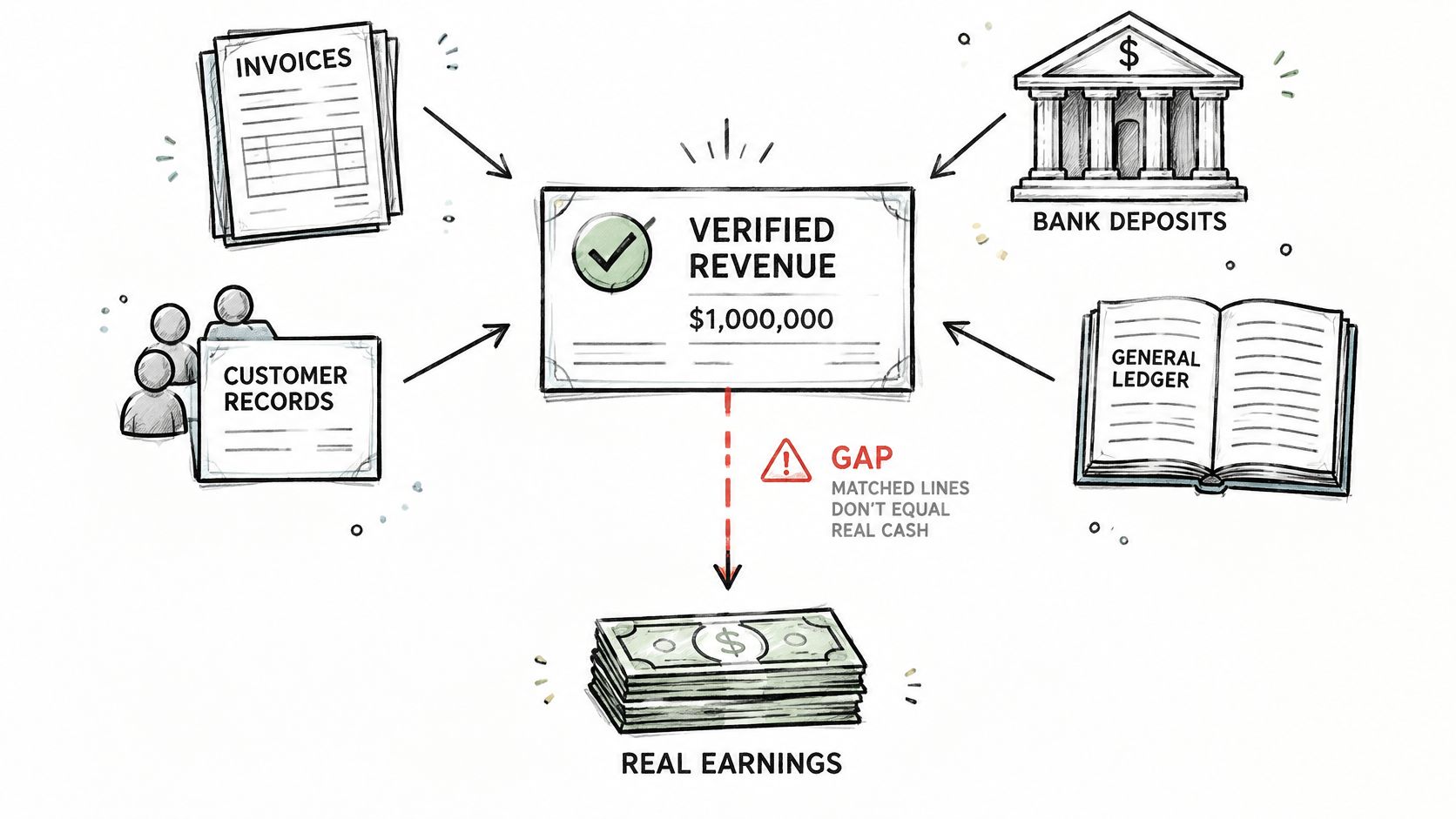
A thorough buyer reconciles reported revenue not only to processor records but also to bank deposits, tax returns, invoices, customer-level data and the general ledger. Legitimate differences can appear at every step. Tax is passed onward, fees reduce payouts, refunds reverse sales, and timing can move a payment across a period boundary. Differences call for an explanation, not an accusation.
| Item | Why It Changes the Number | How to Check It |
|---|---|---|
| Processor fees | Gross sales are higher than net payouts | Compare gross sales with net payouts for the same period |
| Refunds and chargebacks | Reduce realized revenue after the sale | Match refunds and disputes to the period of the original sale |
| Taxes collected | Passed to authorities and not earned revenue | Confirm the figure excludes tax |
| Multiple payment accounts | Revenue is missed if an account is not connected | Confirm every account is connected and in scope |
| Foreign exchange | Currency conversion shifts totals between periods | Confirm the conversion method and rate date |
| Timing cutoffs | Payments near a period end land in the wrong month | Check the period boundary against payout dates |
| One-time sales | Inflate a figure that is not recurring | Separate them from MRR before comparing |
A provider-connected figure can prove transactions were processed. It cannot, by itself, show whether that revenue is recurring, profitable, collected in cash, concentrated in a few customers, or repeatable next year. Direct-source data improves credibility without establishing sustainable earnings. Diligence still has to test cutoff, concentration, churn and repeatability.
The same headline metric carries different accounting meanings across models. A SaaS business reporting monthly recurring revenue and an e-commerce store reporting monthly sales are not describing comparable things, even when both figures reconcile perfectly to their processors. Subscription revenue depends on renewal behavior. Store sales may depend on traffic, seasonality and one-time purchases. The number can be accurate and still answer the wrong question.
A five-step sequence for any listing
- Read the status label first. Listings created before verification was required are marked Not verified yet, and their figures carry correspondingly less weight.
- Confirm the metric and the basis. Is this MRR, ARR, total revenue or net revenue, and is it gross or net of refunds?
- Check the twelve-month history against the signals above, looking for revenue growth without subscriber growth.
- Ask the reconciliation questions on fees, refunds, taxes, currency and cutoff. Vague answers here are informative.
- Test concentration, churn and repeatability across several periods, not one.
BootstrapArena displays what the billing provider reports and does not audit the underlying business. That narrows the questions rather than answering all of them. Submitting a listing takes a couple of minutes: you add your website and revenue key, verify, and AI fills in the rest of the listing from your site.
If you are weighing what a business is worth rather than what it sells, this piece on how buyers price profit, not sales explains why turnover alone misleads. When you are ready to run the process yourself, this walkthrough of selling a business privately covers the sequence from first disclosure to close.
A verified figure narrows the questions. The remaining questions, about concentration, churn, cutoff and cash collection, decide whether the business is worth buying or comparing at all.